Product 02 · Sense Wallpapers
Sense Wallpapers
Live wallpapers drawn from thousands of moving dots of ink: the real Moon as it is in the sky tonight, rain on glass, the year as seven rings, a turning tesseract and more. Made to sit behind Sense Launcher. Anything drawn from your steps or screen time stays on your phone.
-
Moon
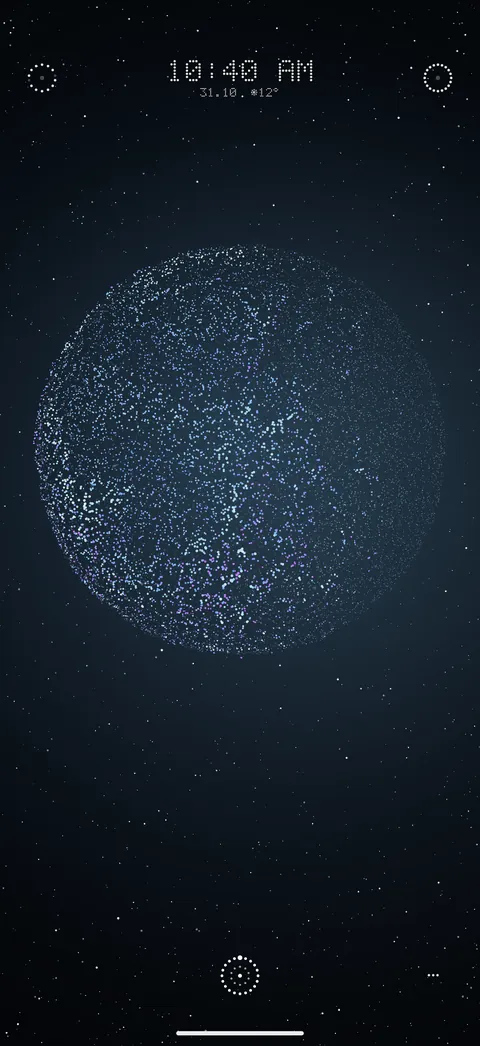
The Moon, as it is tonight
The work
The oldest picture there is, redrawn in ink. This is the real Moon: the surface from NASA’s orbiting cameras and laser altimeter, turned and lit exactly as it is in the sky right now. The phase on your wall is the phase outside tonight, so no two nights are alike and none of them is invented.
Where it comes from
The picture rests on two NASA maps of the Moon, one of how bright its surface is and one of how high it stands. Where the Moon is in its orbit, how it is tilted towards us, and where the Sun is are worked out on your phone from astronomical formulas (Jean Meeus’s Astronomical Algorithms), and they agree with an independent astronomy library to a few hundredths of a degree. Nothing is downloaded and nothing is sent anywhere.
How to look
Over a month the Moon rocks and nods, a few degrees each way, so a little more of each edge comes into view. That libration is real and it is applied. The high ground is shaded towards purple, and craters and mountains catch the Sun most along the line between day and night.
Every so often the camera swings right round to the far side, the half we never see from Earth. The Sun keeps its place, so as you go round the lit half passes into darkness, and a faint earthshine keeps the unlit side readable. Customise sets the phase (now, a time-lapse of a month, or one you choose), the relief, the size and how often it turns.
-
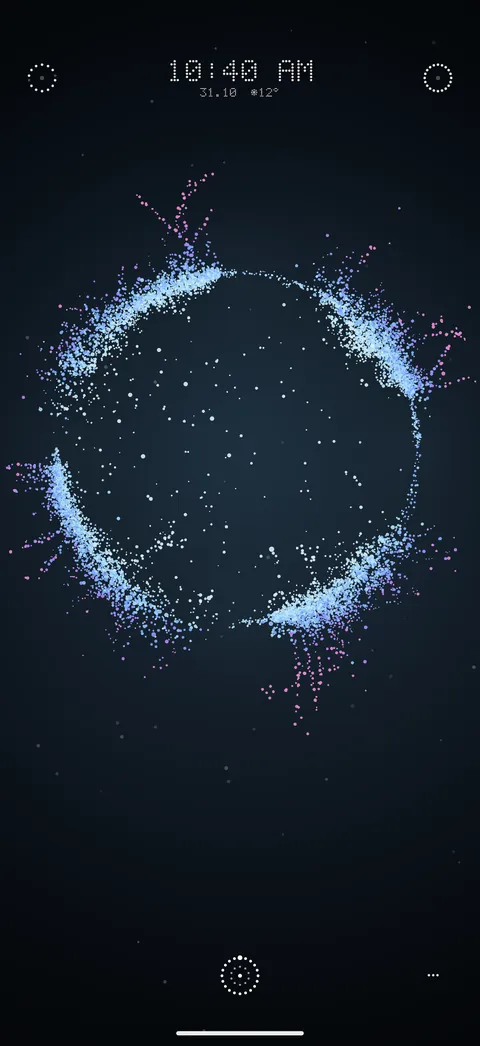
Space ink live
Today, as a ring
The work
A portrait of the day you are actually having. The mark is a ring, and the ring is a clock: midnight at the top, time running clockwise, and every hour thickened with the ink of your own steps and your own screen time.
No two days make the same picture, and nobody else can own yours.
Reading the ring
The ring is a 24 hour clock. Midnight is at the top and time runs clockwise: 6 am on the right, noon at the bottom, 6 pm on the left. Ink outside the ring is your steps. Ink inside is your screen time. The busier the hour, the more ink.
The white bead is now. Behind it is the day you have had, in solid ink. Ahead of it is the day to come, in faint ink, a guess from your usual routine. If an alarm is due later today, a drop of ink is flung out of the ring at its hour.
Your data
Space ink live uses two things your phone already knows: your steps (needs Physical activity) and your screen time (needs Usage access). Each becomes 24 numbers, one for every hour, used only to draw the ring. They stay on your phone and are never sent anywhere.
Steps are logged as your phone reports them, so on the first day the ring may look partly empty. The last week is used to guess the faint hours ahead. With neither permission, Space ink live shows a random mark like Space ink. Allow them on this app’s main screen.
-
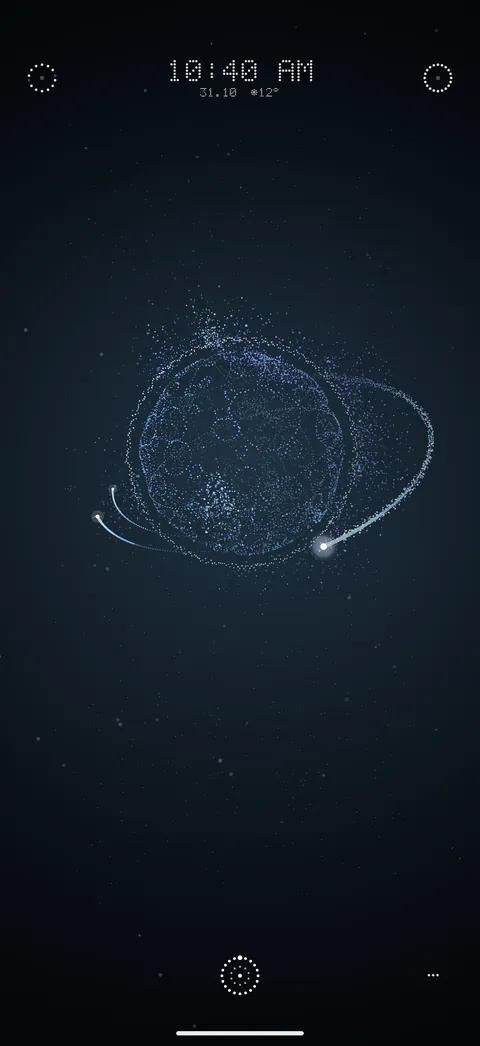
Orbit
A planet that keeps the time
The work
A very fine planet made of thousands of motes: a pitted, airless world, ringed with craters like the Moon’s, under a faint grid of latitude and longitude, turning slowly in real 3D while its surface ripples and glitters. Loose swarms of dust stream round it, and three small white satellites go round it, one for the hours, one for the minutes and one for the seconds.
It is half sculpture, half clock, and it keeps better time than it lets on.
How it tells the time
It reads like a 24 hour clock with midnight at the top. The largest satellite, on the outer orbit, goes once round the planet in 24 hours, so where it is tells you the hour. It leaves a wake of motes behind it, starting from midnight and travelling clockwise, like the ring in Space ink live, so the length of the wake is the day so far. Four small knots of motes mark midnight, 6 am, noon and 6 pm. A smaller satellite on an inner orbit goes round once an hour and shows the minutes, and the smallest, inside that, goes round once a minute and sweeps the seconds. When one slips behind the planet it dims but never disappears.
Battery and your day
A thin arc round the planet is your battery: the lit part is how much is left, it turns pink when it falls to a fifth, and it breathes while charging. A drop of ink marks your next alarm.
With Physical activity and Usage access allowed, the wake shows your day: where you walked it sprays outward in pink, and where you used the phone it sprays inward in blue. The time, the battery, your steps and your screen time are read on your phone and stay there.
-
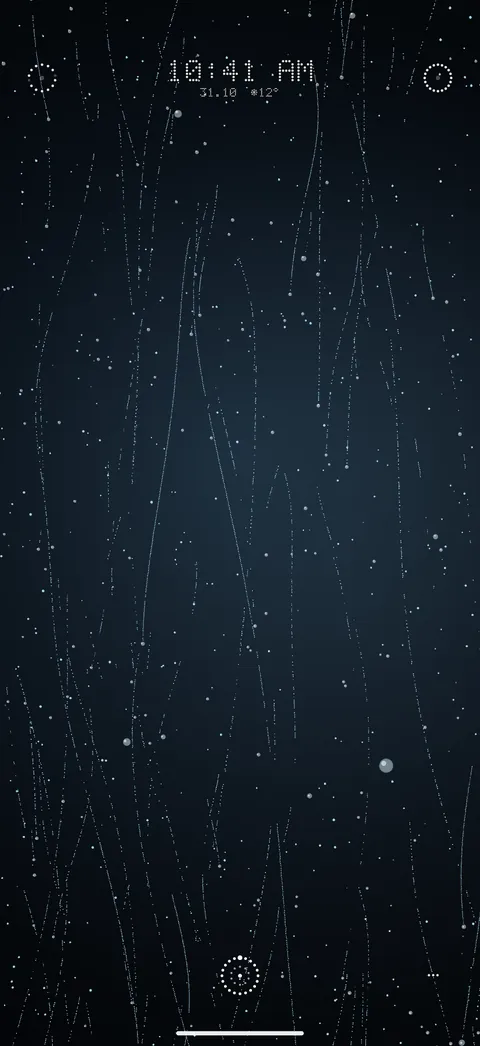
Rain
Rain in space
The work
Rain on a window, remembered rather than recorded. Every drop is a single mote of ink, and the glass they run down is nothing but the way they move. It is the quietest work in the collection, and the closest to looking out at nothing in particular.
How it is made
Small drops cling to the glass where they land. Big ones let go and run, sweeping up the drops in their way. Now and then the view swings round so you can see that the glass is a box, a pane of ink with weather inside it, before it settles back to the window.
In Customise you choose the weather, the wind, the tint of the glass and how strong it is, and how often the view turns.
Touch and tilt
Touch the glass and it answers. By default a finger wipes a clear patch through the ink. Touch can also be set to Drip, or to Lean only if you would rather not disturb it. With the gyroscope on, the whole window tilts as you tilt the phone, so the rain seems to hang a little way in front of the screen.
Nothing here needs a permission.
-
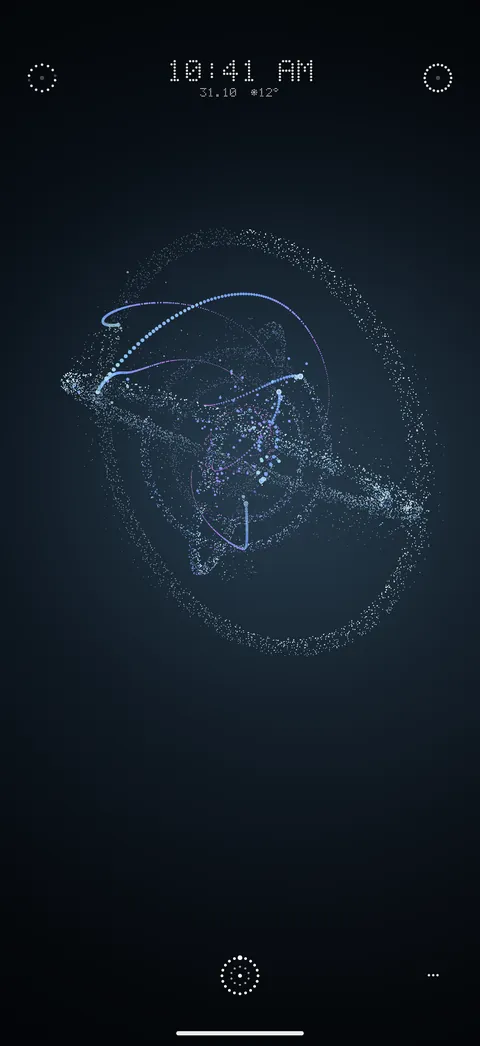
Rings
The year, as seven rings
The work
Time, laid out as a single object. Seven rings of ink hold the year, the month, the week, the day, the hour, the minute and the second, and each one fills clockwise as its span runs out. It is a clock, but it is also a chart of how much is left, and how small a second looks beside a year.
How it is made
Each ring is a loop of motes with a bright hand on its edge. At rest they sit flat, like concentric circles. Every so often the rings tumble like a gyroscope, each turning about its own axis, while the camera swings round, and then everything settles flat again.
Camera sets whether it turns now and then, never stops tumbling, or stays still, and Turn every sets how often. All of it is worked out from your phone’s own clock.
How to look
Watch the second ring and the year ring together: one is a blur, the other has barely moved since you last looked. Future decides how the time still to come is shown: Faint, Lit or Hidden. Echo and Trails set how long the rings keep ghosts and wakes of where they have just been, and Pull sets how strongly the older ink is drawn in towards the middle.
Touch the picture to lean the whole thing towards your finger. No permission is needed.
-
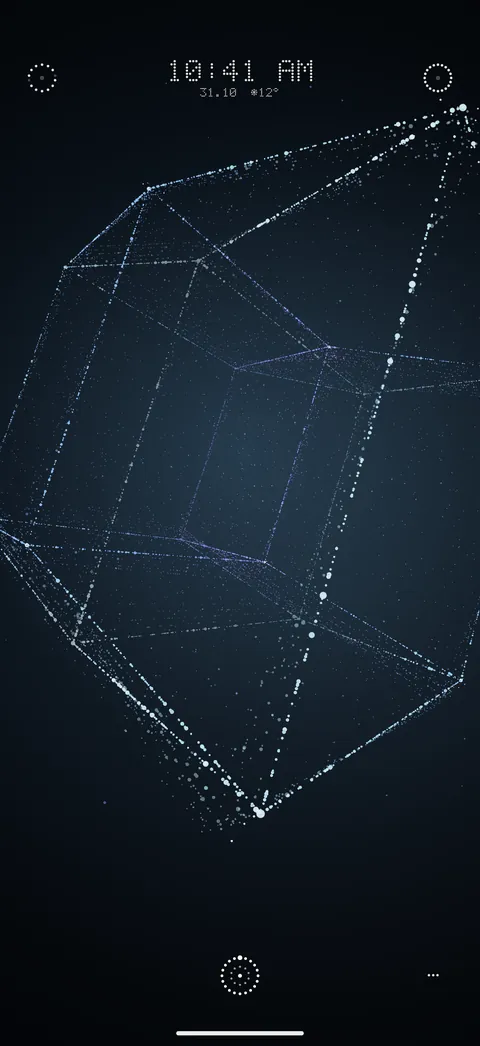
Tesseract
A shape from a fourth dimension
The work
A cube that does not exist in our space, shown the only way we can see it: as a shadow. A tesseract is a cube in four dimensions, and here it turns through the fourth. The small cube inside swells while the big one folds in, and for a moment inside and outside trade places.
How it is made
A tesseract has 16 corners, 32 edges, 24 square faces and 8 cubes, and the picture draws them in motes. Its four-dimensional turning is worked out every frame and squashed down to the three dimensions a screen can show, so what you see is its shadow, which is why the shape seems to pass through itself.
Style sets whether only the edges are drawn or the faces too, and Inside adds one or two more tesseracts nested within.
Touch and tilt
Drag a finger across the picture to twist the cube in your hand. Spin sets how fast it turns by itself, Size how much of the screen it takes, and Echo how long its edges leave ghosts of where they were. With the gyroscope on, tilting the phone tilts the whole shape.
No permission is needed.
-
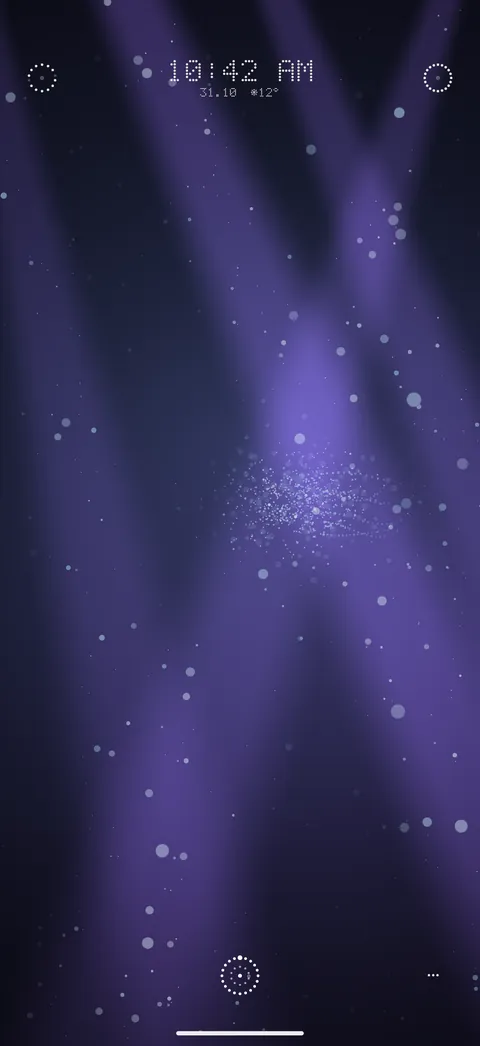
Deep
Deep water, and something in it
The work
The deep, where the light gives out. Slow shafts of it still reach down from far above and sweep gently across the water, and whatever they touch is briefly there: specks of drifting life, and now and then something much larger that nobody has named.
How it is made
Every speck, and every creature, is made of motes of ink. The specks sink slowly: near ones are large and sit in front, far ones are small and sit back in the murk. Three presences swim slow loops through the water. They are not drawn so much as gathered: soft, heavy clouds of motes, thick at the heart and thinning at the edges, with a few slow lights moving inside them. A bloom trailing long veils, a ribbon like a rope of smoke, a broad sheet that ripples as it passes. Now and then a bubble, or a small cluster of them, wobbles up from the dark and away.
In Customise you choose how many creatures swim, how many rays of light reach down (or none), whether they stay still or sweep, the colour of the water, the current, and whether the camera now and then swings round to show it all in depth.
Touch and tilt
Drag a finger through the water and the specks are pushed along, then settle back into their sinking. Touch can also be set to Lean only. With the gyroscope on, tilting the phone slides the near specks further than the far ones, so the water seems to have depth behind the glass.
Nothing here needs a permission.
-
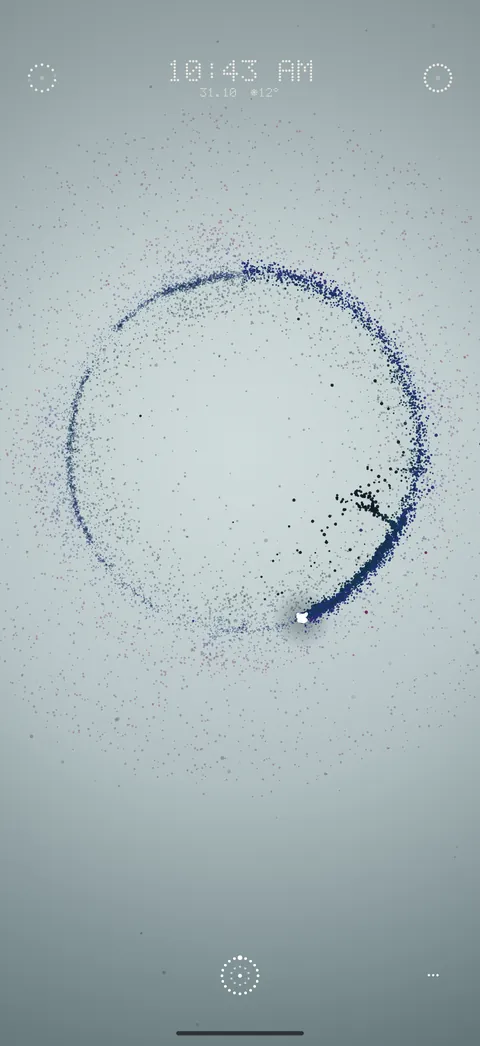
Space ink live (pale)
Today, as a ring
The work
A portrait of the day you are actually having. The mark is a ring, and the ring is a clock: midnight at the top, time running clockwise, and every hour thickened with the ink of your own steps and your own screen time.
No two days make the same picture, and nobody else can own yours.
Reading the ring
The ring is a 24 hour clock. Midnight is at the top and time runs clockwise: 6 am on the right, noon at the bottom, 6 pm on the left. Ink outside the ring is your steps. Ink inside is your screen time. The busier the hour, the more ink.
The white bead is now. Behind it is the day you have had, in solid ink. Ahead of it is the day to come, in faint ink, a guess from your usual routine. If an alarm is due later today, a drop of ink is flung out of the ring at its hour.
Your data
Space ink live uses two things your phone already knows: your steps (needs Physical activity) and your screen time (needs Usage access). Each becomes 24 numbers, one for every hour, used only to draw the ring. They stay on your phone and are never sent anywhere.
Steps are logged as your phone reports them, so on the first day the ring may look partly empty. The last week is used to guess the faint hours ahead. With neither permission, Space ink live shows a random mark like Space ink. Allow them on this app’s main screen.